

Many companies have been approaching us with questions about if they qualify for a Wikidata page and whether Wikidata is useful for GEO (“Generative Engine Optimization”) / AI answer optimization.
While many people have a general understanding of how Wikipedia works, Wikidata is a mystery to most. Both Wikidata and Wikipedia are projects of the Wikimedia Foundation, but they operate independently and are very different from each other.
Wikidata’s format as a highly-structured source of data about a huge range of topics has made it an important source of information used by LLMs such as ChatGPT, Claude and Google Gemini. As highly structured data is especially easy for AI to understand, Wikidata has also become of great interest for its role in GEO (“Generative Engine Optimization.”) For companies, institutions, executives, and public figures, Wikidata can play an important role in how information about them is organized, connected, and interpreted by the LLMs.
Wikipedia pages are still generally much more important to LLMs than Wikidata pages. But the threshold of “notability” for Wikidata is lower, so your company might qualify for it independently of Wikipedia. The two projects maintain separate definitions and standards for “notability”.
That’s not to say that Wikidata notability standards are still strict. Pages can and do get deleted from WikiData both for failing “notability” and for being executed poorly. We see this all the time. So caution is required before jumping in. The project also falls under the Wikimedia Foundation Terms of Service requiring disclosure of any conflict of interest. You may hire an outside Wikidata consultant but they also must disclose their conflict of interest and that they were hired by you.
What is Wikidata?
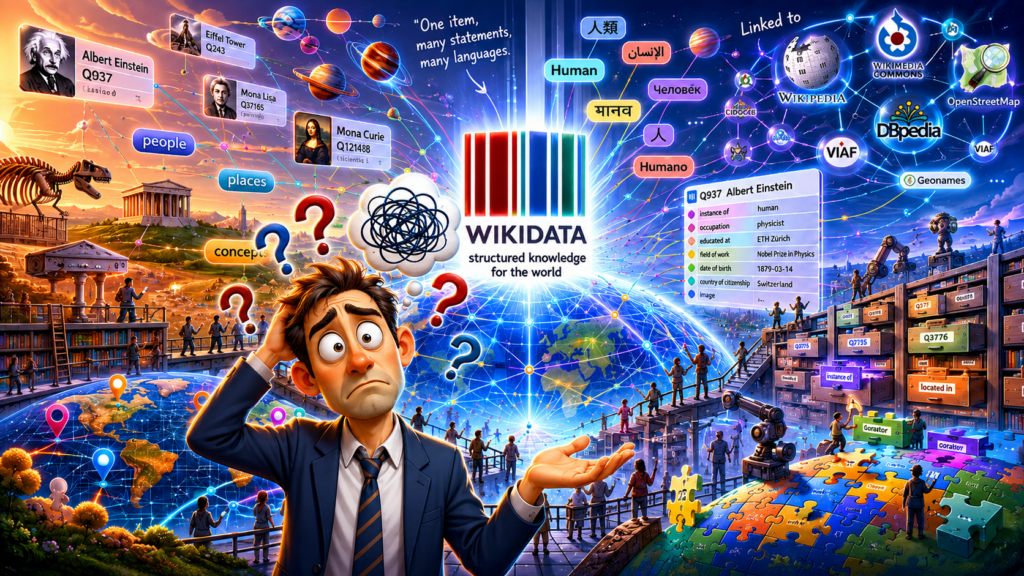
Wikidata is a free, collaborative database. The easiest way to understand the difference from Wikipedia is this: Wikipedia is made of articles, while Wikidata is made of structured facts.
A Wikipedia article about a company describes things like its history, products, and leadership narrative, paragraph form. The Wikidata entry about the company, however, stores those facts as structured data points.
Instead of a sentence like “The company was founded in 2014 and is headquartered in New York,” Wikidata might store that information as individual statements:
instance of: business
inception: 2014
headquarters location: New York City
official website: company.com
industry: software
founder: Jane Smith
Each Wikidata entry is called an item, and each item has a unique identifier. These identifiers usually begin with the letter Q, followed by a number. This structure makes Wikidata useful not just for people, but for machines. AI, search engines, databases, and other platforms use Wikidata to understand that a subject is a specific entity, not just a string of words.That may sound technical, but the basic idea is simple: Wikidata helps organize facts so they can be read, reused, and connected across systems.
So how does wikidata notability work?
The hurdle for Wikidata notability isn’t as difficult to clear as Wikipedia’s. But Wikidata does maintain its own tough set of requirements. In general, an item will be considered notable if it meets at least one of three criteria: It has a valid sitelink to another Wikimedia project, it refers to a clearly identifiable entity that can be described using serious and publicly available references, or it fulfills a structural need within Wikidata.
Let’s break down the criteria:
A valid sitelink to another Wikimedia project – like Wikipedia (or the lesser known sites like Wikisource or Wikibooks) – is the most straightforward way to demonstrate notability for Wikidata. But most companies or people with questions about Wikidata probably don’t have an associated Wikipedia article, which makes the next two criteria very important.
A clearly identifiable entity that can be described using serious and publicly available references is somewhat similar to Wikipedia’s notability policy. This condition requires that details about the item can be verified in accessible, independent sources. The definition of “serious sources” isn’t expressly included in Wikidata policy, but editors tend to agree that sources independent of the subject, not user-generated, and not primarily promotional count as “serious.” This includes independent news coverage, respected industry publications, and certain major library or authority databases. Sources that wouldn’t be considered “serious” include user-generated databases, promotional profiles, self-published materials (like press releases or LinkedIn profiles), routine directories, and sources without clear editorial oversight. Through discussion, Wikidata editors have agreed that IMDB, ISNI, Crunchbase, and Discogs should generally not be accepted as proof of Wikidata notability since they are not wholly independent of their subjects. .
And finally, Wikidata also recognizes something called structural need. This means an item may be appropriate because it helps make other Wikidata items more useful. For example, Wikidata commonly accepts items for CEOs or founders of companies that already have a sitelink, because those people may be needed to describe the company accurately. Similar logic can apply when an organization is needed to explain a notable product, publication, institution, event, or relationship.But structural need should not be treated as a loophole. The fact that one item is connected to another notable doesn’t automatically confer notability. Wikipedia has a very similar policy against inherent notability.
But at the end of the day, these criteria comprise a lot of grey area. Just like on Wikipedia, Wikidata editors don’t always agree on whether certain sources or conditions are enough to satisfy the notability requirements. Editors are engaged in frequent discussions over qualifying sources. And just because a source was allowed in one case doesn’t mean it will be allowed in another. That’s where a qualified Wikidata consultant can help. Our years of experience parsing policy and archived discussions allow us to build the strongest case possible for Wikidata notability.
How is wikidata different than wikipedia?
Wikipedia and Wikidata are related, but they are not the same thing. This distinction matters because it’s easy to assume that Wikidata is just a less important offshoot of Wikipedia. It’s not. Wikidata has its own purpose.
Wikipedia is an encyclopedia designed to be read by people. Wikidata is designed to store facts in a structured format that computers can understand, compare, and reuse.
Wikidata also has its own inclusion standards. While it’s generally easier for a subject to have a Wikidata item than a full Wikipedia article, that doesn’t mean every subject automatically qualifies.
Does a company or person need a wikipedia page to have wikidata?
No. A Wikipedia page is not required in order to have a Wikidata item.
This is one of the most common misconceptions about Wikidata. Many Wikidata items are connected to Wikipedia articles, but a Wikipedia article is not required in every case.
Here’s an example: A Wikipedia consultant on our team recently worked with an entrepreneur who didn’t yet qualify for a Wikipedia page. Though the person was extremely successful in his field and had credible press coverage, he did not yet have enough independent, in-depth sourcing to meet Wikipedia’s strict notability standards.
This entrepreneur was preparing to launch a new venture and AI search visibility was his top priority. Wikipedia was off the table for the time being, but we created a neutral, properly sourced Wikidata item that helped establish him as a structured entity online. This gave LLMs, search engines and other data-driven platforms clearer information to work with: who he is, what he is associated with, and how his public information connected across the web. For someone launching a new company, that kind of entity clarity can be valuable because LLMs and search engines are not just looking for keywords; they are trying to understand relationships between people, organizations, websites, press coverage, and public records.
But Wikidata is not a free business directory.
Simply having a company website, LinkedIn page, press release, or incorporation record does not necessarily mean a company should have a Wikidata item. Wikidata has its own Notability standards, which we’ll cover in the next section.
This is where many companies get into trouble. They hear that a Wikipedia page is not required and assume that Wikidata can be used as an easy substitute. It can’t be and publishing poorly done oats can lead to companies being blocked from Wikidata in the future.
The real question to ask is, “Is there enough serious, independent public information to create a neutral, reliable, detailed and well-structured record about this company?”
How does wikidata affect aI visibility and gEO?
Wikidata can help with Generative Engines Optimization because it helps LLMs understand entities in such a structured manner.
Traditional SEO often focuses on keywords, website structure, backlinks, content quality, and technical performance. Those things still matter.
But LLMs want to understand what a page or organization represents in the real world.
This is where entity optimization comes in.
An entity is a distinct thing: a company, person, product, etc. When LLMs and search engines understand an entity clearly, they can connect it to related information across the web. Wikidata can support that process by providing structured facts about the entity.
For a company, Wikidata may help clarify basic information such as:
official name
legal name
headquarters
founding date
founder
industry
parent organization
subsidiaries
official website
social profiles
external database identifiers
But creating a Wikidata entry doesn’t guarantee LLMs will describe your company accurately (or include it among competitors.) Although Wikidata is valuable, by itself, it won’t turn a little-known business into a notable public entity. GEO has become a multifaceted discipline that requires highly specialized analytics and tactics. Since 2023, our sister company Citate.ai has offered the first platform and professional services in this field.
Wikidata is one source sometimes used as part of GEO services. It can contribute to a stronger entity footprint when it is accurate, properly sourced, and consistent with other authoritative information online. LLMs often rely on patterns of corroboration. When your company’s facts are consistent across trusted sources, it becomes easier for machines to understand who you are, what you do, and how you relate to other entities.
why data consistency matters
One of the most useful things about Wikidata is that it can help reinforce consistent public information.
At WhiteHatWiki, we confront inconsistencies in data all the time. Companies are often described one way on their website and marketing materials and another way in news coverage. Facts are often outdated, miscontextualized, or simply inaccurate. For the purposes of Wikipedia, we have to sort out these discrepancies by using reliable sources to appeal to human reason – actual editors.
But we can’t engage in a dialogue with the algorithms driving LLMs and search engines. For robots, even small inconsistencies in data can create big problems.
This is an important way that Wikidata can help. It acts as one structured reference point among many. It can connect a company to the correct identifiers, official website, public records, and related entities.
This is especially relevant in AI answers. LLMs can misunderstand entities when public data is thin, inconsistent, outdated, or ambiguous. A clean Wikidata item can be part of a broader strategy to make an entity easier to identify and describe accurately.
How nOT to use wikidata
Companies should avoid treating Wikidata like a promotional profile.
That means no marketing copy, no exaggerated claims, no keyword stuffing, no unsourced awards, no selective puffery, and no attempts to use Wikidata as a substitute for a company website.
Wikidata is designed for structured facts, not brand messaging. Statements should be neutral and verifiable. A company can be defined relative to its category. It should not be described as “the leading innovative provider of next-generation solutions,” even if that phrase has been picked up from marketing materials and repeated in other sources.
Companies should also be careful about conflict of interest. If you work for the company, own the company, represent the company, or have been hired by the company, you have a conflict of interest. The Wikimedia Terms of Service require public disclosure of any conflict of interest. It is also the position of the Wikimedia Foundation that in many jurisdictions, failure to make a proper conflict of interest disclosure can be against the law.
How can whiteHatWiki and citate.ai help?
WhiteHatWiki and Citate.ai work closely together to help organizations and individuals evaluate whether Wikidata makes sense as part of a broader Wikipedia, GEO, SEO and reputation management strategy. That includes reviewing sources, assessing notability, identifying entity gaps, and determining whether a neutral, properly sourced Wikidata item is appropriate.
Please contact us for a complimentary assessment.